

Survival Of The Fittest
Not every Crypto project that launches survives, never mind succeeds. It’s not always a case of a project being an intentional scam, but rather of things not going according to plan or as well as expected. This is, unfortunately, a part of life and very much a part of the Crypto and blockchain space. Despite being 17 years old, the space remains highly experimental.
DePIN is still a relatively new concept. The term DePIN was only coined a few years ago. As with business in general, successful projects are often mimicked and duplicated. This was particularly evident in 2024 and 2025, when bandwidth-sharing applications and browser extensions were a hot topic. The bear market has, of course, removed many players from the board. However, many have survived.
I will highlight a few of these projects that continue to reward users and their machines. These projects have a proven track record. That doesn’t mean they are infallible. However, when choosing DePIN applications, these are your safest bets.
Grass
Yes, Grass is the project that began all the hype in 2024, along with projects like Hivemapper. Grass is a standard Google Chrome browser extension that enables users to earn GRASS points, which are later converted to GRASS tokens, which had an astronomical rise in 2025. Grass remains one of the most successful airdrops of the previous bull market and continues to soldier forward despite the environment.

Grass also has a strong AI component, making it a well-positioned play for DePIN enthusiasts looking to benefit from the Machine Economy with minimal risk. Being a free application, there isn’t any real risk of loss. Grass is a set-and-forget system. As long as your laptop is on, points are mined. There is also a mobile application. To earn more, connect additional WI-FI connections. GRASS can be traded on multiple exchanges, including Gate.io, MEXC, and various DEXs.
Silencio
Despite being hit hard by the bear market, this little DePIN earner has the potential to be a little gold mine. Silencio’s core service is the mapping of noise pollution. Users record noise pollution in their respective areas and are rewarded with SLC tokens at the end of every month. There is also the Voice AI option, which also rewards users.

There are also four daily raffle tickets, which ensure even higher monthly earnings of SLC. Silencio is built on Peaq and had an amazing initial airdrop. I was somewhat disappointed that I never mined more points. Many top wallets earned thousands of dollars with the initial airdrop and launch of the SLC token. SLC can be traded on Gate.io.
DeNet
Next, we have DeNet, a project centered around decentralized storage. DeNet perhaps holds the most opportunity as it has yet to launch its token via the initial airdrop. You might be wondering why I have listed DeNet as a trusted DePIN project when it is still so young. DeNet is one of the top projects being built on Peaq has a massive community.
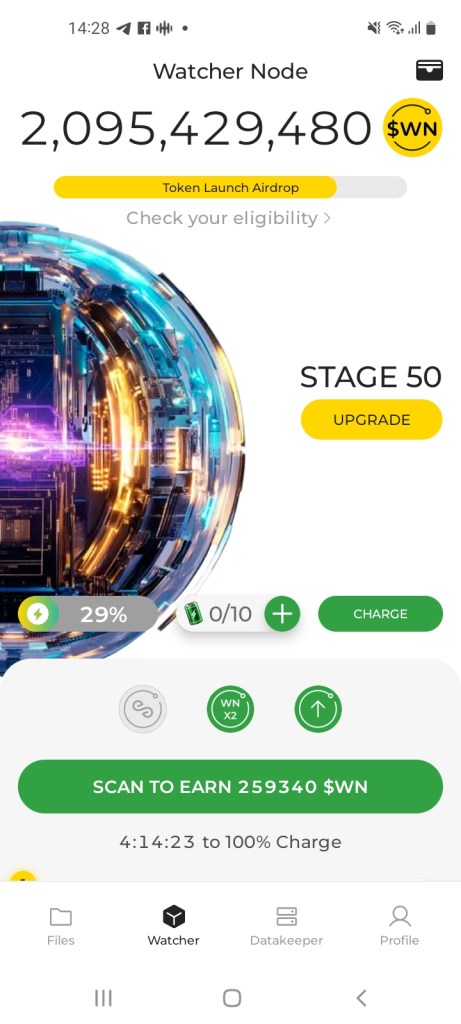
The project has also introduced physical nodes to the market. DeNet is a serious project and not just another bandwidth-sharing application. DeNet solves a real problem and is extremely relevant in modern society. DeNet is also positioned to be the leader in this particular sector and the expression of DePIN.
UpRock
UpRock is a Solana-based DePIN that primarily revolves around the traditional concept of bandwidth sharing. The project has been around for some time. It’s a low-earning, trusted DePIN that could perform well once altcoins begin rallying. The UPT token can be traded on MEXC and various DEXs.

The team is also very engaged with the community and hosts podcasts quite frequently. It is important to note that UpRock’s market cap is only $1.3 million. A 10X to 20X is easily attainable in a full-blown bull market. It’s also easy enough to mine via a mobile application.
Final Thoughts
DePIN remains an exciting niche despite relatively low overall interest in the space. However, mining free tokens over an extended period with the intention of holding them is a good idea, as there isn’t much to lose. Some of these projects are micro-caps, which makes them risky by default. However, if they are achieved without capital deployment, the risk is largely eliminated. Thanks for stopping by. See you next time!
 Sapphire Crypto